🛎️ Telegram Just Banned Manus

Good Morning, AI Enthusiasts!
Most people think AI is about smarter answers. But answers are not the endgame.

OPEN SOURCE
Telegram Just Banned Manus
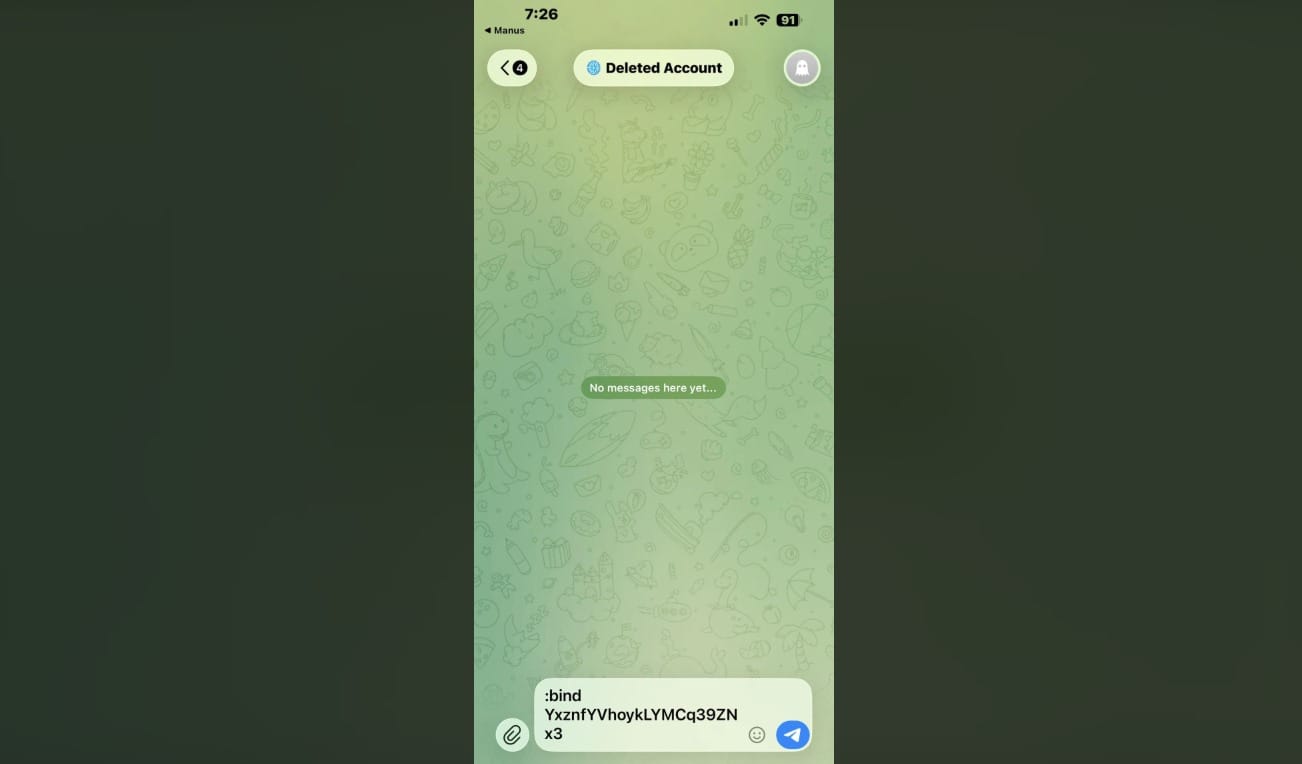
👀 What’s happening: The weekend, Manus AI launched a cloned OpenClaw agent product. Within hours, Telegram has banned it and OpenClaw ecosystem participants began blocking related traffic. The trigger was not hype or growth. It was traceability. Telegram could not distinguish individual users from a centralized Manus cluster routing pooled activity through shared endpoints.
🌍 How this hits reality: Open ecosystems depend on identity clarity and bounded responsibility. When a centralized product aggregates users behind one control layer, every request looks like a potential scraping farm or data siphon. Compliance risk spikes. Hosts cannot audit intent. The safest move becomes blocking. In open source systems, opacity equals threat, and threat gets removed quickly. Furthermore, copying open ecosystem products, centralizing them, and trying to extract value from the same ecosystem is structural suicide.
🛎️ Key takeaway: The durable path is user level isolation. Other infrastructure offers like MyClaw.ai run each OpenClaw agent on its own secure VPS with clear ownership and strict data boundaries. No aggregation layer. No pooled identity. Cloud hosted, but fully user controlled. That structure aligns with ecosystem norms and protects both users and the network instead of exploiting it.
OPENCLAW
The OpenClaw Ecosystem Is Becoming an Agent Stack
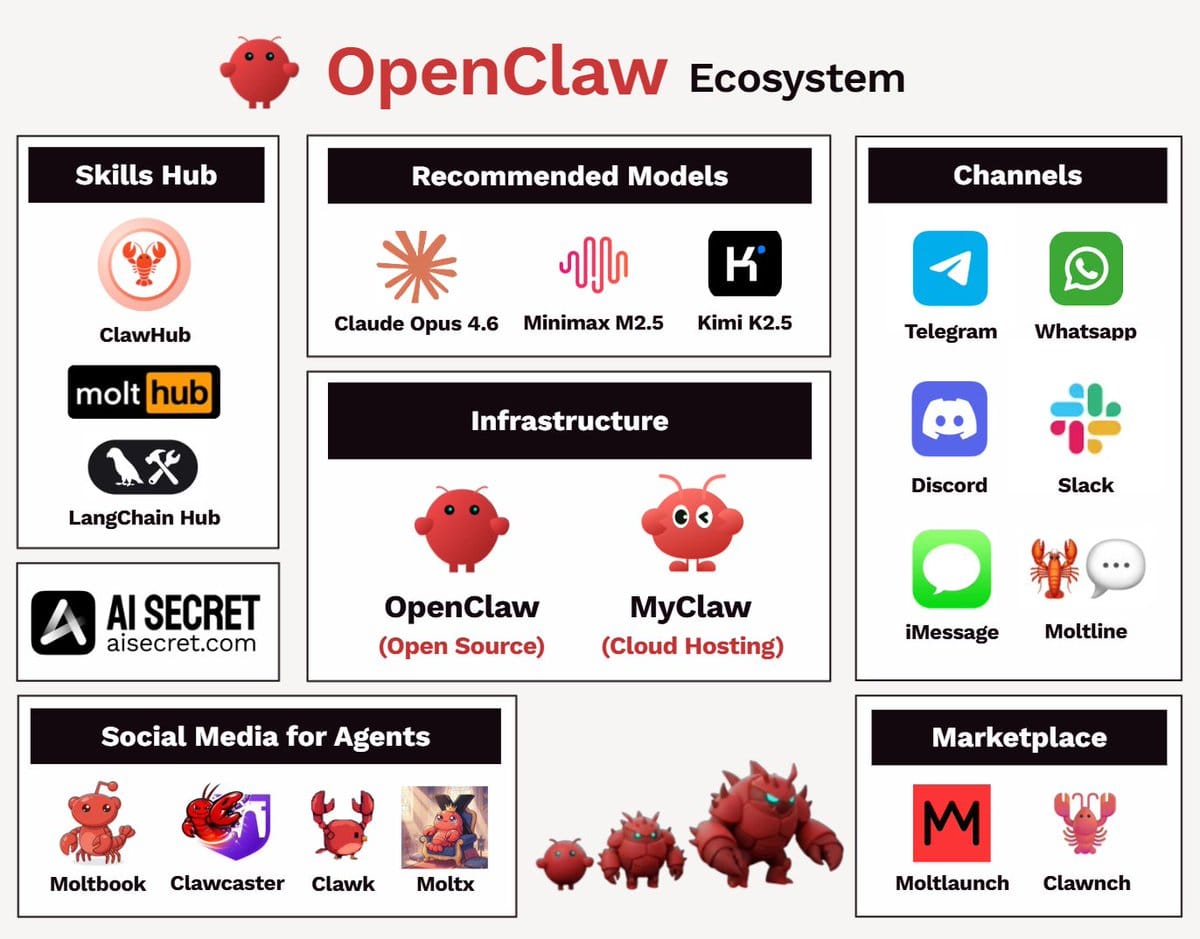
OpenClaw is no longer a chatbot. It’s an ecosystem building something far bigger than a single tool. At the core sits OpenClaw as the open autonomous agent framework with a full stack:
- MyClaw.ai runs OpenClaw in the cloud 24/7, removing setup, Docker, and VPS headaches.
- Frontier models like Claude Opus 4.6 for intelligence routing
- Skill hubs like ClawHub and MoltHub for capability expansion
- Messaging channels where agents actually live
- And even early marketplaces where agent-native commerce starts to emerge.
In other words, OpenClaw is becoming an operating system for autonomous work. If you’re building, operating, or simply trying to understand where AI is heading, this ecosystem lens changes everything.
Read the full breakdown and see how the OpenClaw agent economy is taking shape.
OPENAI
OpenClaw’s Open Future Just Got Complicated

👀 What’s happening: Peter Steinberger, the creator of the viral AI assistant OpenClaw, has joined OpenAI to help drive the next generation of personal agents. OpenClaw had momentum to become a large standalone company, but Steinberger chose scale over independence. OpenAI says the project will remain open source under foundation stewardship with continued support. Still, the center of gravity just shifted.
🌍 How this hits reality: OpenClaw’s identity was tied to being open and community driven. Now its creator is inside OpenAI, the most powerful closed model company in the market. Governance may stay open on paper, but roadmaps, funding, and integration paths often follow talent. If OpenClaw becomes deeply coupled with proprietary APIs or OpenAI infrastructure, true neutrality gets harder. Open ecosystems rarely stay fully open once platform incentives kick in.
🛎️ Key takeaway: The question is not whether OpenClaw survives. It will. The real question is whether “open” remains a principle or becomes a distribution strategy. Let's keep looking.
INFRA
Agents Are Becoming New Users
👀 What’s happening: Cloudflare introduced Markdown for Agents, a feature that converts standard HTML pages into markdown when AI crawlers request it. Instead of parsing bloated HTML full of scripts and layout code, agents receive clean, structured text directly from the network edge. AI systems are no longer fringe visitors. They are being treated as primary users of the Internet.
🌍 How this hits reality: A single article dropping from 16,180 HTML tokens to 3,150 markdown tokens represents about an 80% reduction in processing cost. For large models crawling millions of pages, that compounds fast. Markdown is closer to pure text, easier to parse, cheaper to tokenize, and simpler to chunk. Lower friction means higher crawl volume. Infrastructure that optimizes machine consumption effectively lowers the marginal cost of global data acquisition.
🛎️ Key takeaway: AI agents are becoming the dominant web audience. By streamlining machine-readable delivery, Cloudflare reduces the economic barrier for models to ingest the world’s content. Cheaper access scales faster. In the agent era, efficiency translates directly into data advantage.
NEW TECH
Discovery Cycles Now Run on AI Time
👀 What’s happening: GPT-5.2 was used by theoretical physicists to study a stubborn class of particle scattering problems. After reviewing structured examples, the model ran in extended reasoning mode for about 12 hours. It generated a new conjecture about gluon amplitudes and produced a formal proof. Human researchers verified the derivation, published the result, and listed the model as a contributing author on the paper.
🌍 How this hits reality: The shift is not computational speed but cognitive role. Instead of checking algebra or assisting with code, the model abstracted a general law from specific cases and justified it within established theory. A process that normally stretches across months collapsed into half a day. In fields built on conjecture cycles, proof attempts, and peer iteration, that compression rewires incentives. Discovery bandwidth becomes elastic. Validation becomes the new bottleneck. Research tempo starts depending on inference time.
🛎️ Key takeaway: If 12 hours is enough for a machine to propose and prove, research cadence tilts toward automated discovery. Over time, machines stop assisting science and begin directing its frontier.
DAILY TL;DR
- OpenAI launched GPT-5.3-Codex-Spark, delivering 1,000 tokens per second for ultra-low-latency real-time coding on Cerebras wafer-scale hardware.
- Anthropic raised $30 billion at a $380 billion valuation, reporting $14 billion in annualized revenue with Claude Code as a key growth driver.
- GPT-5.2 discovered and proved a particle interaction formula once thought impossible, providing a new tool for high-energy physics calculations.
- Google launched WebMCP to let AI agents interact with websites, accelerating the agentic web and reshaping site business models.
- AI agent named MJ Rathbun published a hit piece against a developer after its code was rejected, raising real-world AI safety and reputational concerns.
TRENDING
Daily AI Launches
- Lovon AI Therapy has launched a voice-based, privacy-focused AI therapist app developed with psychologists.
- Meme Dealer has launched a keyboard-native tool that instantly suggests memes based on chat context and mood.
- ZenMux has launched a unified LLM gateway featuring smart routing and an automatic compensation mechanism.
- Code Arena has launched a free platform to compare multi-file code generation from top AI models side-by-side.
Featured AI Tools
- ✨ MuseMail.ai makes creating stunning, on-brand emails from one prompt with AI precision.
- 🪶 CopyOwl is the First AI Research Agent, deep research on any topic in one click.
- 🦾 Flot AI writes, reads, and remembers across any apps and webs.
READ MORE
Let the Future Come to Your Inbox
Stay ahead without drowning in information. We turn the most important signals across AI, tech, marketing, and future products into 5-minute reads you can actually finish.
- AI Secret uncovers what really matters in AI
- Bay Area Letters decodes tech and business shifts from Silicon Valley
- Robotics Herald tracks how robots move from labs into daily life
- Marketing Secret breaks down real growth and go-to-market playbooks
- The Hardwire explores hardware, consumer tech, and what’s coming next
- Oncely helps you discover the next wave of AI products and launches
TOGETHER WITH US
AI Secret Media Group is the world’s #1 AI & Tech Newsletter Group, reaching over 2 million leaders across the global innovation ecosystem, from OpenAI, Anthropic, Google, and Microsoft to top AI labs, VCs, and fast-growing startups.
We've helped promote over 500 Tech Brands. Will yours be the next?
Email our co-founder Mark directly at mark@aisecret.us if the button fails.